
Polar Stratospheric Clouds Explained: How Lidar Helps Us Monitor the Stratosphere
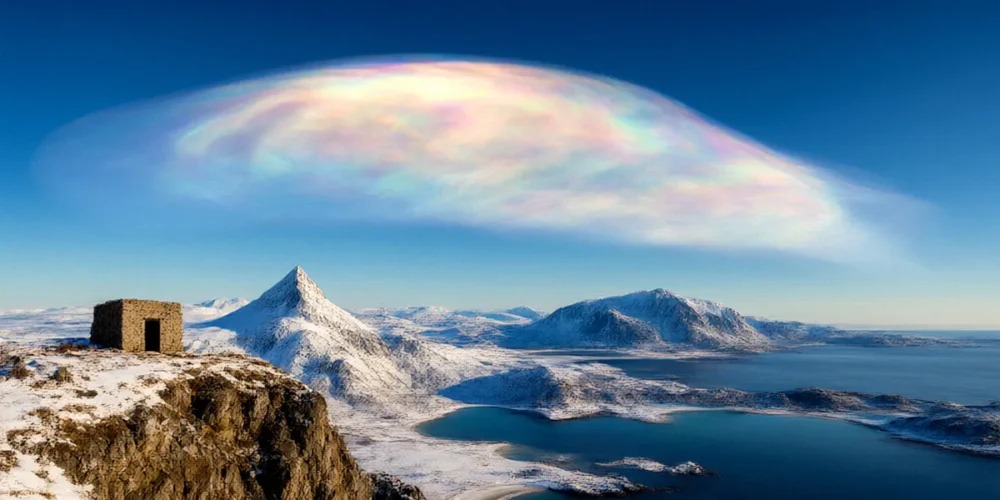
On a cold winter evening, skywatchers across northern Scotland and parts of England occasionally witness something extraordinary: luminous, mother-of-pearl clouds drifting high above the horizon, glowing long after sunset. These nacreous clouds are beautiful, but they carry a troubling message. They are polar stratospheric clouds (PSCs), and they form in the same atmospheric layer where the ozone layer sits. Understanding why they appear — and what they do to ozone chemistry — is one of the reasons we at NDACC spend so much time pointing lasers at the sky.
What Are Polar Stratospheric Clouds?
Polar stratospheric clouds are clouds that form in the stratosphere, typically between 15 and 25 kilometres above the Earth’s surface. At these altitudes the air is extremely dry and extremely cold. For a PSC to form, temperatures must drop below roughly -78°C, which happens almost exclusively inside the polar vortex during winter. Because they sit so high and catch sunlight from below the horizon, PSCs are also known as nacreous clouds — from “nacre”, meaning mother-of-pearl — and they display iridescent colours that make them unmistakable to observers on the ground.
Their beauty masks their significance. PSC particles provide surfaces on which chemical reactions take place, and those reactions are central to polar stratospheric ozone depletion.
Types of Polar Stratospheric Clouds: Type I and Type II
Atmospheric scientists generally divide PSCs into two families:
- Type I clouds form at temperatures around -78°C and consist of nitric acid trihydrate (NAT) particles, sometimes with sulphuric acid and water. They are the more common type and are further split into Type Ia (solid crystalline particles) and Type Ib (liquid or amorphous droplets).
- Type II clouds require even colder conditions, below about -85°C, and are composed of pure water ice. They are less common but tend to produce the most vivid nacreous displays.
The distinction matters because the two types have different particle sizes, shapes and optical properties — and lidar instruments can tell them apart.
Where and When They Form
PSCs are essentially a polar phenomenon. They form inside the winter polar vortex over Antarctica and, less reliably, over the Arctic. The Antarctic vortex is colder and more stable, so PSCs are far more widespread and persistent there. In the Arctic, formation depends on how cold a given winter becomes. PSCs are rarely observed over the UK, but they have been spotted during sudden stratospheric warming events when unusual circulation patterns push cold stratospheric air towards our latitudes.
Why Polar Stratospheric Clouds Matter for Ozone
Without PSCs, the chlorine and bromine that reach the stratosphere from chlorofluorocarbons (CFCs) and halons largely stay locked in inactive “reservoir” molecules such as hydrogen chloride (HCl) and chlorine nitrate (ClONO₂). PSC particles change that. Their surfaces host heterogeneous reactions that convert these reservoirs into far more reactive forms, setting the stage for rapid ozone destruction when sunlight returns in spring.
The Chemistry of Chlorine Activation
The key reactions occur on or within PSC particles. Chlorine nitrate and hydrogen chloride react on particle surfaces to produce molecular chlorine (Cl₂) and hypochlorous acid (HOCl), among other products. These species are photolysed by sunlight into free chlorine atoms, which then enter catalytic cycles that destroy ozone — often without being consumed themselves. A single chlorine atom can destroy thousands of ozone molecules before being removed from the cycle. This is why PSC formation is regarded as the essential precondition for the severe ozone depletion seen over Antarctica each spring.
Links to Arctic Ozone Depletion Events
The Antarctic ozone hole is the best-known consequence, but the Arctic matters too. In cold Arctic winters, PSCs can form over large areas and lead to significant — if less dramatic — ozone losses. Because the Arctic vortex sometimes shifts towards mid-latitudes, these depletion events can influence ozone levels over Europe, including the UK. The British Antarctic Survey leads polar ozone research that connects PSC observations directly to ozone depletion, and its long-term records have been central to our understanding of how stratospheric chemistry responds to both human emissions and climate variability.
How Lidar Detects Polar Stratospheric Clouds
Lidar — light detection and ranging — is one of the most powerful tools we have for studying PSCs. A lidar instrument fires short pulses of laser light into the atmosphere and measures the light that is scattered back to a receiver telescope. By timing the return signal, we build a vertical profile of the atmosphere with fine altitude resolution, often down to tens of metres.
Backscatter and Depolarization Measurements
Two measurements are especially useful for PSC work:
- Backscatter ratio — the ratio of light scattered back by particles to that scattered by molecules alone. Elevated backscatter reveals the presence of cloud particles or aerosol layers.
- Depolarization — the degree to which the returning light has changed polarization. Solid, non-spherical particles such as NAT crystals depolarize light strongly, while spherical liquid droplets do not. This lets us distinguish between different PSC types.
Raman lidar techniques add another dimension by measuring inelastic scattering from nitrogen or water vapour molecules, which helps constrain temperature and humidity profiles alongside the cloud observations.
NDACC Lidar Network and PSC Monitoring
NDACC — the Network for the Detection of Atmospheric Composition Change — coordinates ground-based remote sensing stations around the world, including several with lidar capabilities. These stations profile PSCs and stratospheric aerosols on a routine basis, building the long-term records needed to detect trends. The NDACC lidar station at Rothera Research Station in Antarctica is operated by the British Antarctic Survey, and it provides some of the most valuable PSC and ozone measurements from the heart of the Antarctic vortex.
UK Contributions to PSC and Ozone Research
The UK has a long and distinguished history in stratospheric science. The University of Cambridge and the Rutherford Appleton Laboratory have been involved in ground-based lidar measurements of the stratosphere for decades, developing instruments and analysis techniques that feed directly into international networks. Their work supports both process studies — understanding how PSCs form and evolve — and long-term monitoring of ozone and related species.
British Antarctic Survey and Polar Campaigns
The British Antarctic Survey (BAS) is a world leader in polar ozone research. BAS scientists have participated in numerous Antarctic campaigns combining lidar, ozonesondes, satellite data and chemistry models to link PSC observations to ozone depletion. Their work at Rothera and other Antarctic sites has documented the seasonal cycle of PSC formation and the subsequent springtime ozone loss.
NDACC Station at Rothera and UK Lidar Sites
The NDACC lidar station at Rothera Research Station in Antarctica, operated by BAS, is a cornerstone of the network’s polar coverage. In addition, NDACC includes UK-affiliated lidar sites that contribute to long-term ozone monitoring and atmospheric composition records. Together, these stations help ensure that the UK remains a key contributor to global stratospheric observation.
Observing PSCs Over the UK: Challenges and Opportunities
PSCs are rarely observed over the UK. Our stratosphere is usually too warm, and the polar vortex sits too far north. But when sudden stratospheric warmings disrupt the vortex, cold air can be displaced southwards, occasionally bringing PSC-favourable conditions within reach of UK observers. These events are scientifically valuable because they let us study PSC formation outside the deep polar night.
Sudden Stratospheric Warmings and PSC Visibility
A sudden stratospheric warming (SSW) is a rapid rise in polar stratospheric temperatures, often accompanied by a breakdown or displacement of the vortex. During and after an SSW, the disturbed circulation can transport cold, PSC-prone air to lower latitudes. This is when nacreous clouds have been reported over the UK. For our team, these events are opportunities to test our understanding of PSC microphysics under unusual conditions.
Combining Lidar with Satellite Observations
No single instrument tells the whole story. Satellite instruments such as those on ESA and NASA platforms provide broad spatial coverage of PSCs and stratospheric aerosols, while ground-based lidars deliver high-resolution vertical profiles at specific locations. Combining the two improves both datasets: satellites help place lidar measurements in context, and lidar provides ground-truth for satellite retrievals. Citizen science reports of nacreous clouds also add useful sightings that can guide targeted observations.
The Future of PSC Monitoring and Atmospheric Science
Looking ahead, advances in lidar technology promise more capable and more deployable instruments. Meanwhile, the long-term datasets maintained by NDACC remain essential for detecting trends and evaluating the effectiveness of the Montreal Protocol.
Next-Generation Lidar Systems
New lidar systems are becoming smaller, more automated and more energy-efficient, which makes it easier to install them at remote sites. Improvements in laser technology, detector sensitivity and data processing are also increasing the altitude range and precision of measurements. For PSC research, these advances mean we can characterise particle types and sizes more accurately than ever before.
Long-Term NDACC Data Records
NDACC’s strength lies in its commitment to consistency. By maintaining calibration standards and measurement protocols across stations, the network produces data records that span decades. These records are indispensable for understanding how stratospheric ozone and PSCs are responding to climate change — and for verifying that international agreements continue to protect the ozone layer.
FAQ
What exactly are polar stratospheric clouds?
Polar stratospheric clouds are clouds that form in the stratosphere at altitudes of 15–25 km when temperatures fall below about -78°C. They are composed of nitric acid trihydrate (Type I) or water ice (Type II) particles and are also known as nacreous clouds because of their iridescent appearance.
Why are PSCs important for ozone depletion?
PSC particles provide surfaces for heterogeneous chemical reactions that convert inactive chlorine reservoirs such as HCl and ClONO₂ into reactive forms. When sunlight returns in spring, these reactive species drive catalytic ozone destruction, which is why PSCs are central to the Antarctic ozone hole and to Arctic ozone loss events.
How does lidar detect polar stratospheric clouds?
Lidar fires laser pulses into the atmosphere and measures the light scattered back. Backscatter ratio reveals the presence of cloud particles, while depolarization distinguishes solid, non-spherical particles from spherical droplets. Raman techniques add information about temperature and humidity.
Can PSCs be seen over the UK?
They are rarely observed over the UK because our stratosphere is usually too warm. However, during sudden stratospheric warming events, cold air can be displaced southwards and nacreous clouds have been spotted over the UK.
What is NDACC’s role in PSC monitoring?
NDACC coordinates ground-based remote sensing stations worldwide, including lidar sites that profile PSCs and stratospheric aerosols. The NDACC lidar station at Rothera Research Station in Antarctica is operated by the British Antarctic Survey, and UK-affiliated sites contribute to long-term ozone monitoring.
Understanding polar stratospheric clouds through lidar is vital for protecting the ozone layer. The NDACC global network, including the UK’s contributions through the British Antarctic Survey, the University of Cambridge and the Rutherford Appleton Laboratory, remains essential for tracking stratospheric change and ensuring that future generations inherit a healthy ozone layer.